A physicist proved your days are actually getting shorter, and the math is not on your side
A Duke Physicist Proved Why Time Speeds Up As You Age. A Child's Same Afternoon Feels Endless.
In 2019, a Duke engineering professor published a peer-reviewed theory for something everyone already suspects: time truly does move faster as you get older. The same hour holds less of it than it used to.
In 2019, Adrian Bejan, a mechanical engineering professor at Duke University, published a paper in the journal European Review with a plain, almost uncomfortable title: why the days seem shorter as we get older.
Bejan was not writing about feelings or nostalgia. He was writing about physics, and about the brain. His argument: what we experience as time is really a stream of mental images, and the mind marks the passage of time by how many new images it registers.
**As the body ages, the pathways that carry those images slow down. Saccades, the rapid eye movements that gather visual information, happen less often. Neural signals travel further and degrade more along the way. The result is fewer new mental images per clock hour, which means, to the brain, less time has actually passed, even though the clock says otherwise.**
1. The clock is the same. The mind's clock is not.
Bejan's theory reframes something almost everyone notices but assumes is just nostalgia: a summer at eight years old felt enormous, and a summer at fifty feels like it barely happened. He argues this is not a trick of memory. It is a measurable difference in how fast the brain is actually taking in the world.
**A young child's brain processes visual information at a faster rate: more saccades, shorter neural pathways, less signal degradation. Packed into the same sixty minutes, a child's mind registers more distinct moments than an adult's does. More moments means, to the mind, more time.**
Two people can share the same afternoon and live through a different amount of it.
2. This is why 'there's still time' keeps feeling true
The unsettling part of Bejan's math is not that days feel shorter. It is what that does to planning. If every year of adult life is perceived as a smaller fraction of a shrinking present, then 'I'll call and ask about that later' keeps sounding reasonable long after the actual runway has gotten short.
**Bejan's paper builds on decades of related work, including physiologist Robert Lemlich's 1975 estimate that subjective time is roughly proportional to the inverse of age, and philosopher Paul Janet's nineteenth century observation that a year is one tenth of a ten year old's life and one fiftieth of a fifty year old's.** The math has been circling this idea for over a century. Bejan gave it a physical mechanism.
The feeling that 'there is still time' gets stronger with age at exactly the moment it is least true.
3. The child across the table is living through more of the same hour than you are
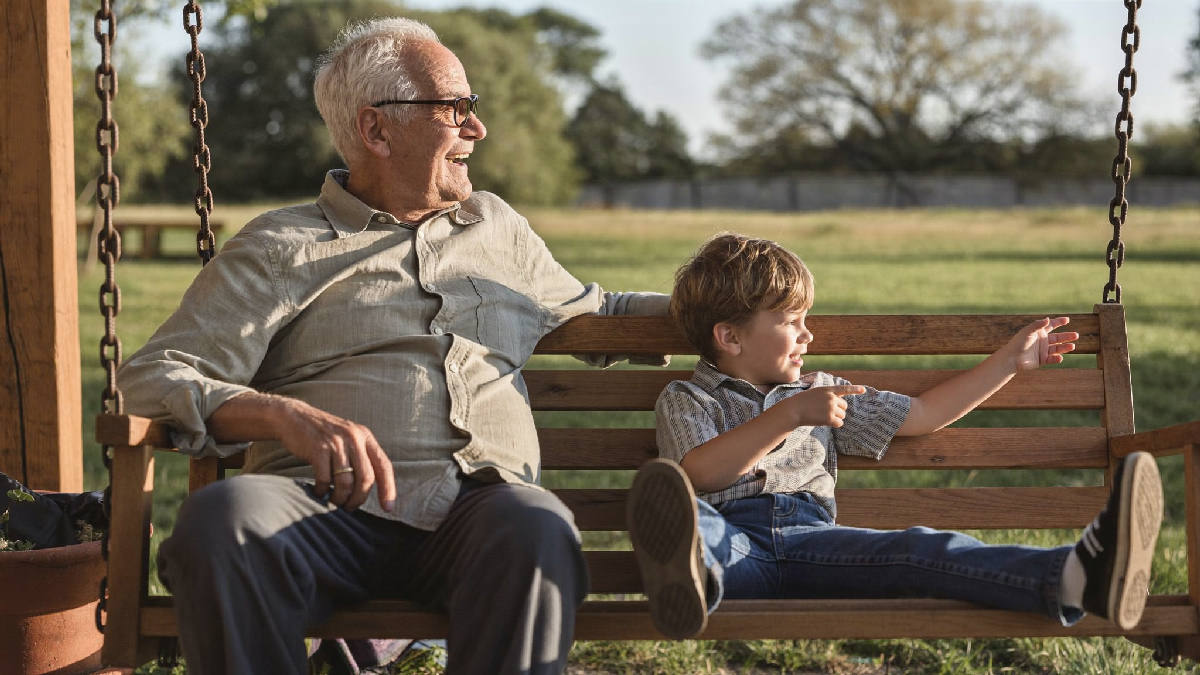
Here is the part that matters for a family. If a grandparent and a grandchild spend a Sunday afternoon together, they are not experiencing the same amount of time, even though the clock ran for the same number of minutes. The child's afternoon is longer. The grandparent's is shorter, and getting shorter every year.
**That mismatch is quiet and easy to miss, because nothing about the day looks different. It just means the adult in the room has less time to work with than it feels like, on a day that already felt unhurried.** The stories, the answers to the questions never quite asked, the version of events only one person remembers, all of it is sitting inside a window that is closing faster than it appears to be.
The afternoon that feels endless to a child is already moving fast for the person telling the stories.
My mom always says 'we have plenty of time' when I bring up recording her stories. I read her this study and she got quiet for a second, then said 'well, maybe not as much as I thought.' We did the first call that weekend.Danielle, 39, recording her mother's stories
What you get with LifeScribe
- Grounded in Adrian Bejan's 2019 study in European Review, 'Why the Days Seem Shorter as We Get Older' (Duke University).
- Ari asks for the real story now, on a call already on the calendar, instead of waiting for a someday that keeps arriving smaller.
- Every answer is kept as an actual recording, in their own voice, not a memory retold later by someone else.
- No special appointment required. Use the next call you already have planned.
Start free, with nothing to lose
Try it on a call you already have planned this week, free. Nothing to install, nothing to learn. If nothing worth keeping comes up, you have lost nothing but a few minutes.
**Bejan's research suggests the very sense that 'there's still time' gets stronger with age, right as the actual time gets shorter.** Ask the question on the call you already have this week.
The same afternoon is shorter for them than it feels.
Pick a call already on your calendar this week. Let Ari ask for the story once, while there is still time to ask.
Questions grandparents ask us
What did Adrian Bejan actually study?
Bejan, a mechanical engineering professor at Duke University, published a 2019 paper in the journal European Review arguing that the brain's sense of time is tied to how many new mental images it processes. As the body ages, that processing rate slows, saccades occur less often and neural signals travel more slowly, so the same clock hour contains fewer perceived moments.
Is this just a metaphor, or an actual physical mechanism?
Bejan proposed it as a physical mechanism rooted in the aging nervous system, not a metaphor. It builds on older observations, including Paul Janet's nineteenth century proportional theory of time (a year is a larger fraction of a child's life than an adult's) and Robert Lemlich's 1975 estimate that subjective time roughly tracks the inverse of age.
Does this mean children really experience time differently than adults?
According to Bejan's theory, yes. A child's brain processes visual and sensory information at a faster rate, registering more distinct mental images across the same clock hour, which the mind interprets as more time having passed.
Why does this matter for families?
It means a shared afternoon is not experienced equally. The older person in the room is living through less of that same hour, and that gap widens every year, even on days that otherwise look unhurried.
How does this connect to LifeScribe?
Ari asks a family member for their real stories on a call already happening, once, before the sense of 'plenty of time' outlives the actual time left to ask.
https://getlifescribeapp.com/blog/why-time-speeds-up-as-you-age